Information
Welcome to the Storm Browne Enterprises, LLC blog, where we delve into a diverse range of topics, offering insights and solutions to current global issues. From space development to politics, economics, the environment, and cutting-edge technology, especially macro-engineering projects, we aim to keep you informed and inspired.

Exploring the universe and beyond
Our blog covers a wide array of subjects, including space development, global challenges, and the state of the United States. We tackle politics, economics, the environment, and technology, focusing on proposed macro-engineering projects and providing solutions to avoid future disasters.

Join the Conversation
We encourage readers to engage with our content by contacting us with questions, sharing comments, and even contributing their essays for publication. Stay connected with our insights and discussions through our newsletter, or explore our published books. Consultations are also available on any topic covered in this blog.

Stay Updated
New blog posts will be published as new ideas arise or when current world problems or proposals emerge. There is no set schedule, ensuring that our content is always timely and relevant.
Explore Our Content
Delve into our blogs covering keywords such as space development, United States, redemption of the U.S., restorations of American ideals, and world events.
Concept overview: from orbital salvage to a settlement built from reused stages and modules. Another illustration and an essay follows.
Click illustrations to expand them for easier reading.
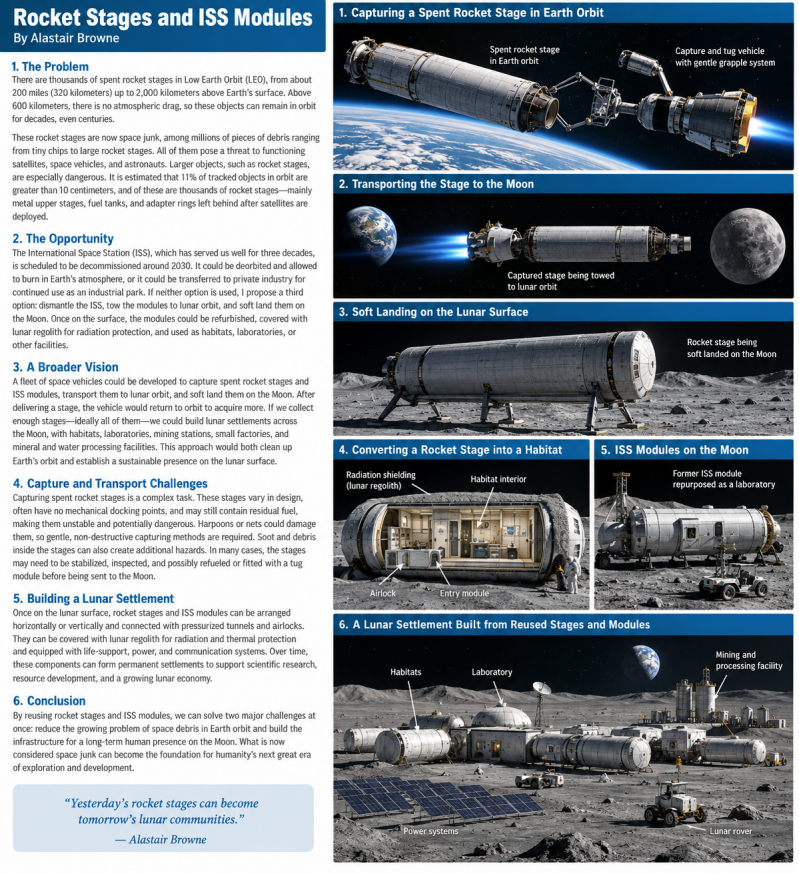
Rocket Stages and ISS Modules
From Space Debris to Lunar Settlements
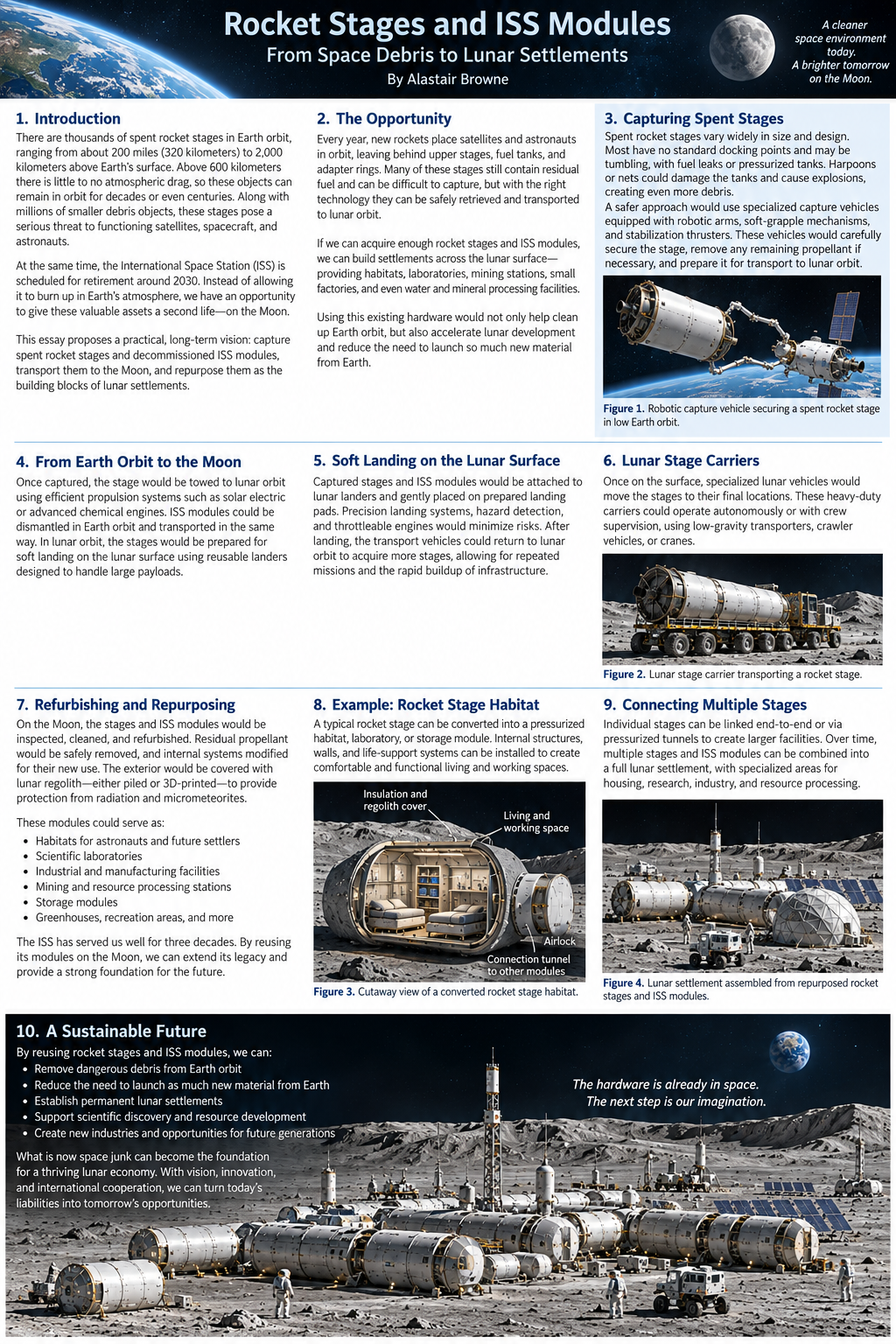
A proposal for capturing selected spent rocket stages and retired space-station hardware, transporting them to the Moon, and converting suitable components into useful lunar infrastructure.
This essay was written and researched by the author and was then revised and illustrated by ChatGPT.
Author’s note: This is an overall view of how spent rocket stages can be refurbished into lunar shelters, labs, and manufacturing plants. The majority of the required work to convert these stages are mentioned, but I do not get into any great detail of any particular concept of science and engineering.
The ISS modules are briefly mentioned. I say briefly because they are ready-made habitats to be placed on the lunar surface immediately, requiring only a few upgrades, so there is no need to take up as much detail as the rocket stages. Rocket stages require much more refurbishing to convert into a lunar habitat, so more attention and details are focused on this process.
I hope this answers any questions you may have, and I hope you enjoy this essay and form your own ideas from it.
1. The Opportunity Hidden in Orbital Debris
Earth orbit contains a large population of discarded hardware: spent upper stages, fuel tanks, adapter rings, and many smaller objects left behind by decades of launches. Some objects in higher orbits can remain there for decades or longer because atmospheric drag is weak. Large abandoned stages are especially important because their size and mass make them potentially hazardous to operating spacecraft, satellites, and future crews.
Instead of viewing every abandoned rocket stage only as waste, we can also ask whether some of this hardware could become a resource. A structurally sound stage already represents material that has been manufactured on Earth and lifted out of Earth's gravity well at great expense. If selected stages could be safely captured, stabilized, inspected, and transported, some might be reused rather than discarded.
This essay proposes a long-term concept: develop a fleet of specialized salvage vehicles capable of retrieving suitable rocket stages, moving them to lunar orbit, and eventually delivering them to the lunar surface. There, the best candidates could be refurbished as habitats, laboratories, storage modules, workshops, or processing facilities. Stages that are unsuitable for habitation could instead be dismantled for metals, plumbing, wiring, structural members, and other useful materials.
2. A Second Life for ISS Hardware
The International Space Station has served as a laboratory, engineering test bed, and human outpost for decades. As the ISS approaches retirement, its eventual disposal raises a broader question: should every useful component necessarily be destroyed during de-orbit, or could some components someday be repurposed?
In this proposal, selected ISS modules and external components would be evaluated before retirement. If future transport systems made the operation practical, modules designed for pressurized human use could be detached in a controlled manner, transferred to a salvage vehicle, moved toward lunar orbit, and delivered to the Moon. Unlike uncontrolled spent stages, ISS modules have known structures and established grapple interfaces, which could make handling them more predictable.
Once on the lunar surface, suitable modules could become laboratories, living quarters, storage spaces, or utility nodes. Other ISS hardware - such as structural beams, radiators, solar-array components, cabling, and mechanisms - could potentially be recycled. This would extend the useful life of hardware that already has an extraordinary history in space.
These are ready-made modules, needing little if any upgrades, and can become useful once they are settled on the lunar surface. These would also be an asset to the space settlement or colony; because they are ready-made, these ISS modules and their functions would be instantly available for use for whatever the settlers may need at the moment.
The rest of this essay will cover rocket stages, for they need the engineering required for refurbishing, and this will take a lot more time and effort.
3. Capturing Spent Rocket Stages
Capturing an abandoned rocket stage would be much more difficult than handling a controlled ISS module. Spent stages differ widely in age, construction, propellant history, surface condition, mass, and rotational motion. Many have no standardized docking or grapple fixtures. Some may contain residual propellant or pressurized systems, and others may have degraded surfaces or loose residue that could produce additional debris if disturbed.
For these reasons, a capture mission should begin with remote inspection. Cameras, lidar (Light Detection and Ranging), radar, thermal sensors, and other instruments could characterize the stage, estimate its rotation, identify likely structural contact areas, and determine whether it is worth recovering. A stage in poor condition could be rejected for habitation and routed, if feasible, to a recycling operation instead.
The actual capture system should emphasize gentle contact. Rather than assuming that harpoons or nets would be appropriate for every object, a future salvage craft could use multiple robotic arms equipped with compliant grippers, soft contact pads, force sensors, and computer-controlled motion. The vehicle would first match the target's orbit and relative motion. If the stage were tumbling, the vehicle and its manipulators would have to synchronize with that motion before making contact.
No single technique would work for every stage. The capture plan would have to be tailored to the individual object. The goal would be to stabilize the stage without puncturing a tank, tearing thin structural material, or creating new debris.
4. The Space Salvage Vehicle
A dedicated salvage vehicle would combine rendezvous capability, autonomous navigation, robotic manipulation, inspection systems, and a secure cradle or support frame for the recovered stage. After capture, the robotic arms would place or draw the stage into the cradle and restrain it for transport.
Some salvage vehicles might be uncrewed, particularly during the hazardous initial capture. Others could operate with a crew supervising from a protected compartment or from a nearby spacecraft. In either case, autonomy would be important because the final centimeters of contact with an unstable object may require rapid, precise corrections.
A large-scale cleanup and reuse program would require many such vehicles. Some would specialize in inspection and capture, others in towing, and still others in transporting hardware from lunar orbit to the surface. Dividing the mission among specialized vehicles may be more practical than requiring one spacecraft to perform every task.
Propulsion would be one of the most demanding parts of the concept. Chemical propulsion offers high thrust but requires substantial propellant. Nuclear thermal propulsion has been studied as a way to obtain higher efficiency than conventional chemical systems by using reactor heat to expand a propellant through a nozzle. Nuclear electric propulsion takes a different approach: a reactor generates electricity for high-efficiency electric thrusters.
These systems have different strengths. High-efficiency electric propulsion is attractive for slow cargo movement between orbits, while high-thrust systems would be more useful for major maneuvers and landing operations. A future architecture might therefore use a combination of propulsion methods rather than a single engine type for the entire mission.
5. From Earth Orbit to the Moon
After a stage is captured and stabilized, it would be prepared for transport. The vehicle would verify structural integrity, secure any moving parts, reduce hazards from residual pressure where possible, and establish a trajectory toward lunar orbit. Because these objects were never designed as lunar cargo, each transfer would require careful mass-property analysis and attitude control.
Once in lunar orbit, the stage could be transferred to a landing system designed for bulky, irregular payloads. Soft-landing large salvaged structures would be a major engineering challenge in its own right. The lander would need sufficient thrust, a broad stability margin, hazard detection, and a method of securing the stage throughout descent.
The preferred landing site would be prepared in advance near the developing settlement. Landing pads should be separated from inhabited structures to reduce the effects of ejecta and dust. After touchdown, the transport system could release the stage and return to lunar orbit for another assignment.
6. Lunar Stage Carriers and Surface Placement
Landing a rocket stage near a settlement is only part of the job. The stage must then be moved to its permanent location. This calls for a lunar stage carrier: a heavy surface vehicle designed to lift, cradle, and transport long cylindrical structures across uneven terrain.
A carrier might use many independently driven wheels, articulated suspension, a low center of gravity, and a long support cradle. Robotic cranes or lifting arms could transfer the stage from the lander to the carrier. The vehicle would then move slowly to a prepared site, where a shallow cradle or foundation would hold the stage horizontally.
Surface transport should be largely autonomous, with human supervision available when necessary. Because lunar gravity is only one-sixth of Earth's, a stage would weigh less than it does on Earth, but its mass and inertia would remain unchanged. Starting, stopping, turning, and stabilizing a large stage would therefore still require careful control.
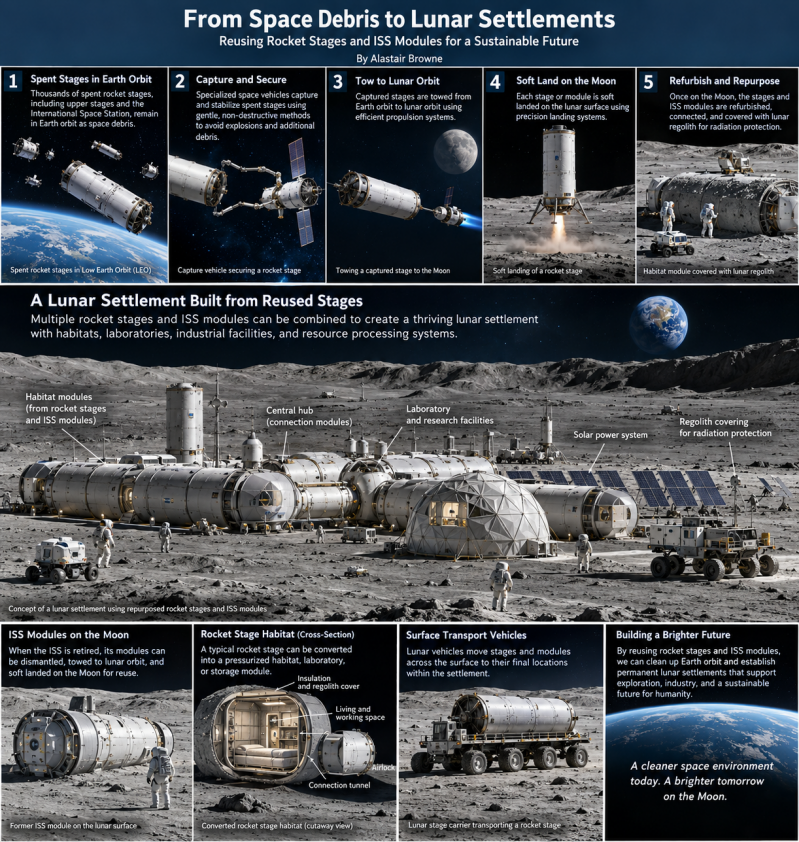
Conceptual sequence showing capture, lunar delivery, a stage carrier, a converted habitat, and a settlement assembled from reused hardware.
7. Why Refurbish Stages on the Moon?
The strongest argument for reuse is that the main structure is already in space. Building a complete habitat on Earth and launching it to the Moon requires paying the mass penalty of lifting every kilogram out of Earth's gravity well. A salvaged stage is not a free habitat - extensive transportation, cleaning, modification, life-support equipment, and shielding would still be required - but its pressure vessel or structural shell could provide a useful starting point.
This idea is related to in-situ resource utilization (ISRU) in a broad sense: use resources that are already available at the destination or in the space environment instead of importing everything from Earth. On the Moon, local regolith could provide shielding, while unusable portions of salvaged stages could supply metals and components.
An initial conventional lunar base would still be necessary. Astronauts and robots would need power, tools, shelter, communications, maintenance facilities, and safe working areas before they could begin converting recovered stages.
8. Refurbishing a Rocket Stage
The most promising candidates for conversion would be large, structurally sound tank sections or other enclosed volumes. The basic idea resembles the historic 'wet workshop' concept: a propellant tank or launch-stage volume is used for one purpose during flight and later converted into habitable space.
Before conversion, the stage would undergo a detailed inspection. Engineers would identify its materials, welds, liners, insulation, valves, residual chemicals, corrosion or radiation damage, and any areas that should not be cut or pressurized. The stage would then be vented, cleaned, and certified before humans entered it without protective gear.
Prefabricated interior kits could be brought from Earth. These might include modular floors, wall panels, wiring trays, plumbing, lighting, ventilation ducts, equipment racks, and expandable room structures. A large-diameter stage could support two decks; a smaller one might use a single deck with a utility space beneath the floor.
Cleaning and Detoxification
Cleaning procedures would depend on the propellant and tank materials. Cryogenic propellants such as liquid hydrogen or methane present different hazards from hypergolic propellants such as hydrazine-based fuels and nitrogen tetroxide. The process could include controlled venting, vacuum exposure, heating, inert-gas purging, chemical sampling, and robotic surface cleaning.
The key principle is that no crew should cut into or occupy a former propellant tank until testing confirms that flammable, toxic, or reactive residues have been reduced to safe levels. The exact procedure would have to be developed for each stage type rather than assumed in advance.
Interstages, Adapters, and Cargo Sections
Not every useful rocket component is a propellant tank. Interstages and payload adapters are designed to carry major structural loads, while cargo sections may provide large volumes that have never contained propellant. These areas could become workshops, storage rooms, utility spaces, or parts of connecting structures.
Because such sections are not necessarily pressure vessels, conversion to living space might require a sealed inner liner or inflatable pressure bladder. Engine bells and thrust structures would generally be poor candidates for habitation, but their metals, pipes, valves, wiring, and structural elements could still be valuable for recycling.
9. Doors, Airlocks, and Structural Openings
A rocket tank is optimized to carry pressure and launch loads, not to have doors cut into its side. Any new opening would therefore require structural reinforcement. One possible approach would be to install a prefabricated collar around the proposed opening before cutting the shell. The collar would spread pressure loads into a larger area and provide a robust attachment point for an airlock or connecting tunnel.
Robotic cutting and welding systems would be preferable for the initial work. Laser, electron-beam, or other vacuum-compatible tools could eventually provide precise cuts, but the exact method would depend on the stage material and wall thickness.
Conventional windows should be minimized because every opening complicates pressure integrity, shielding, and thermal control. High-definition exterior cameras connected to large interior displays could provide virtual windows without cutting additional holes in the pressure shell.
10. The Problem of Lunar Dust
Lunar dust is one of the most persistent hazards facing a settlement. Regolith particles are fine, abrasive, and electrostatically active. They can damage seals, mechanisms, radiators, suits, and interior equipment. A converted rocket stage would therefore need a carefully designed entry system.
The entrance could include an external dust-control zone, an EVA airlock, and an interior dust vestibule. Electrostatic dust-removal technologies, mechanical brushing, vacuum collection, and other methods could be combined to remove particles before a crew member enters the main living area. Any liquid-nitrogen or other cryogenic cleaning method should be treated as an experimental option requiring testing rather than as an assumed operational solution.
Keeping dust outside is preferable to filtering it after it enters. Nevertheless, the habitat's air-handling system would also require high-efficiency particulate filtration as a final defense.
11. Radiation, Micrometeoroids, and Thermal Protection
The thin metal wall of a rocket stage would not by itself provide sufficient protection for long-term habitation. The converted structure should therefore be surrounded by substantial shielding. Lunar regolith is the obvious local material: robotic equipment could pile or place it over and around the stage, creating a protective berm or shell.
The exact shielding thickness would depend on mission duration, location, acceptable exposure, and engineering analysis. Rather than assuming one universal depth, the settlement should be designed around measured radiation requirements and include especially well-shielded storm shelters for major solar particle events.
Regolith also helps moderate temperature swings and provides protection against small meteoroids. Near landing areas, the exposed surface around structures could be stabilized or sintered to reduce loose dust and ejecta. Robotic microwave or laser systems have been proposed for turning regolith into harder surfaces, although large-scale lunar construction methods remain an area for development.
12. Environmental Control and Life Support
A converted tank becomes a habitat only after it receives a complete environmental-control and life-support system (ECLSS). In lunar gravity, as in microgravity, forced air circulation is essential. Fans and ducting would move air through the entire volume, while filters would remove particles and trace contaminants.
Carbon dioxide removal, oxygen generation, humidity control, water recovery, temperature regulation, fire detection, and atmospheric monitoring would all be required. Equipment could be packaged in standardized racks so that systems can be replaced or upgraded without rebuilding the habitat.
A Sabatier system could form part of a closed-loop architecture by reacting carbon dioxide with hydrogen to produce water and methane. Water recovery and electrolysis could then return oxygen to the atmosphere. The details would depend on the settlement's overall water, hydrogen, oxygen, and waste-management systems.
13. Internal Floor Plan
Once a cylindrical stage is laid horizontally, its interior can be organized much like a long building. A large diameter stage might contain two decks, while a smaller stage would use one main deck. The curved space below the lowest floor could carry electrical cables, water lines, waste plumbing, ventilation ducts, and data connections.
Near the main entrance would be the EVA airlock and dust vestibule. Beyond that could be a command-and-control area with habitat monitoring, communications, rover telemetry, and local operations displays. The central portion of the lower deck could contain laboratories, maintenance benches, medical facilities, exercise equipment, and utility racks.
In a two-deck configuration, the upper level could contain crew quarters, a galley, dining space, and recreation areas. Sleeping quarters could be placed farther from the main airlock and heavy work areas. Because people can move differently in one-sixth gravity, interior design should include handholds, padded collision surfaces where useful, and circulation paths designed specifically for lunar movement.
14. From Individual Stages to a Lunar Settlement
The larger vision is not a single converted tank but a community assembled from many specialized modules. One stage might be residential; another a laboratory; another a machine shop or mineral-processing plant. Other modules could serve as a medical center, mess hall, recreation facility, greenhouse support area, warehouse, or utility station.
Stages could be connected end-to-end or linked by pressurized tunnels so that inhabitants would not need to put on spacesuits simply to move between major buildings. Central hubs could connect several cylindrical modules, allowing the settlement to expand in branches as new hardware arrives.
ISS modules could be incorporated into the same network, particularly where existing pressure vessels, hatches, racks, and life-support heritage are useful. Over time, the settlement would become less dependent on salvaged hardware as purpose-built lunar structures, locally manufactured components, farms, and industrial facilities came online. The reused stages would serve as an early bridge between exploration and permanent settlement.
15. Power, Water, and Local Industry
A permanent settlement requires dependable power through the lunar day-night cycle. Solar arrays can provide large amounts of power when illuminated, while storage systems would be needed during darkness. Nuclear fission power is another potential source for continuous electricity and could be located at an appropriate distance from inhabited areas.
Water would be among the settlement's most valuable resources. Recycled water would form one supply, while future lunar extraction - particularly where accessible ice or hydrated materials are available - could reduce dependence on Earth. Lunar mining and processing could also produce oxygen and useful metals.
As local industry grows, damaged or unsuitable rocket stages could become feedstock. Their aluminum alloys, steels, copper wiring, tanks, valves, and other components could be sorted and reused. Eventually, lunar manufacturing could produce replacement parts and structural elements locally.
16. Conclusion: Turning Liabilities into Infrastructure
The concept described here attempts to solve two problems with one long-term strategy. The first is the accumulation of large abandoned objects in Earth orbit. The second is the enormous cost of establishing useful infrastructure on the Moon. If future technology allows selected rocket stages and space-station components to be captured and transported economically, some of that hardware could be transformed from orbital liabilities into lunar assets.
The proposal is ambitious. It depends on advances in orbital debris capture, autonomous robotics, propulsion, heavy lunar landing, surface transportation, tank certification, radiation shielding, dust control, and closed-loop life support. Not every stage would be safe or worth recovering, and purpose-built lunar habitats will remain essential. Nevertheless, the principle of reuse deserves serious consideration: before launching a new structure from Earth, we should ask whether useful material is already available in space.
A successful program could gradually create a network of habitats, laboratories, processing facilities, and support buildings across the lunar surface while simultaneously removing some of the largest abandoned objects from Earth orbit. The first settlements would be experimental and heavily dependent on Earth. Later generations could combine salvaged hardware with lunar resources and locally manufactured structures.
What begins as orbital cleanup could therefore become part of a larger transition - from temporary missions to permanent infrastructure, from discarded hardware to useful resources, and from isolated lunar outposts to thriving communities. It would not be the final form of lunar civilization. It would be a first step.
Illustration Notes
The accompanying concept illustrations are intended to communicate the proposed sequence and architecture rather than depict flight-qualified designs. Future technical illustrations could separately show: (1) a robotic salvage vehicle matching rotation with a tumbling stage; (2) a lunar stage carrier transferring a horizontal stage from a lander to a prepared cradle; (3) a cutaway two-deck rocket-stage habitat; and (4) a settlement map showing residential, laboratory, industrial, power, landing, and resource-processing zones.
Bibliography
Apollo11Space. “Why the Lunar Module Had Such Tiny Windows.” @apollo11space69; https://www.youtube.com/watch?v=7mALD1kdxgs.
Button, Keith. “Scrubbing Away Lunar Dust.” Aerospace America, March 23, 2026. https://aerospaceamerica.aiaa.org/scrubbing-away-lunar-dust/
Cain, Fraser. Frasier Cain/Universe Today Podcast, “Battling Moon Dust With Liquid Nitrogen Spray.” @frasiercain, https://www.youtube.com/watch?v=tWartKovuxw&t=609s.
Cosmic Horizons. “Why Astronauts Live in a ‘Cloud of Dead Skin’ | ISS Cleaning Protocols.” YouTube.com/@cosmicdocumentary; United Kingdom; https://www.youtube.com/watch?v=rQOXqVLiqO8&t=177s.
Let’s Talk Science. Life Support in Space - Closed System. “Life Support in Space: Working Toward a Closed System”
https://letstalkscience.ca/educational-resources/backgrounders/life-support-in-space-closed-systems.
Manley, Scott. “Keeping Astronauts Alive—Everything You Need to Know About Life Support in Space.” YouTube.com/@scottmanley; https://www.youtube.com/watch?v=HvtWhPFGcAY&t=816s.
Mavrakis, Nikos. “Capturing Spent Rocket Bodies with Robots.” Durham University, Space Research Centre. https://www.durham.ac.uk/research/institutes-and-centres/space-research-centre/policy-briefs/spent-rocket-stages/
MIT Media Lab, “Project Rocket Horizon;” Rocket Horizon Team; Space Exploration Initiative..
https://www.media.mit.edu/projects/reusable-rocket/overview/
NASA. “Life Support Subsystems/Life Support System Design and Development.” NASA Johnson Space Center. https://www.nasa.gov/reference/jsc-life-support-subsystems/
Ramirez, Antonio. “In-Space Laser Welding: Building the Future Beyond Earth—Report 2 Ramirez.” AFRL Regional Network—Midwest.; Ohio State University, Columbus, Ohio; https://www.youtube.com/watch?v=7vgSusm1XmY&t=42s.
Veksler, David. “Space Habitats and Life Supports.” https://cheatsheets.davidveksler.com/space-habitats-life-support.html
Lunar Concrete Revisited
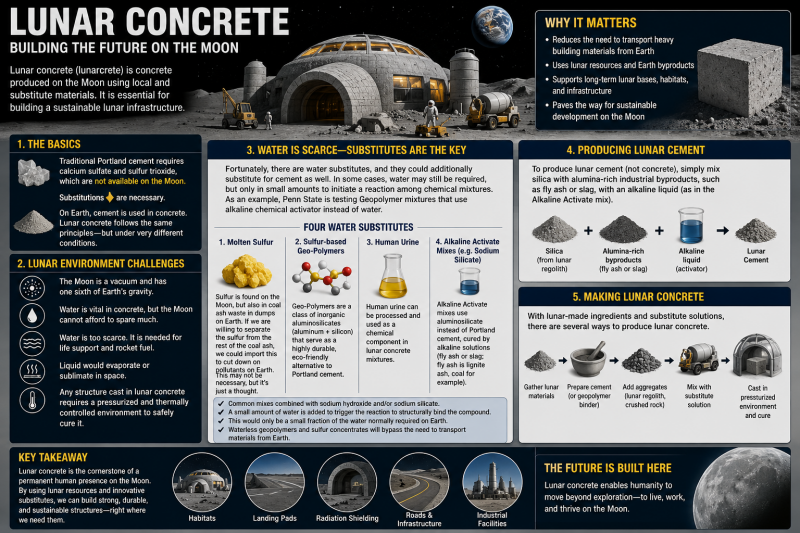
In my book, Building the Space Infrastructure (pp. 138–139), I briefly introduced the concept of lunar concrete (also known as lunarcrete or mooncrete), a material with the potential to surpass the strength of conventional concrete produced on Earth. It is made by crushing lunar rock and combining it with a cementitious binder. When reinforced with steel or glass fibers, its flexural strength increases significantly while reducing the formation of microcracks. Once cured, lunar concrete becomes a highly durable material that can serve as both a structural component and with an interior sealant for pressurized habitats, it helps to retain breathable air. This extraterrestrial form of concrete can be molded into a wide variety of structures suitable for construction on the Moon.
Compared with conventional concrete, lunar concrete is expected to offer superior resistance to compression, extreme temperature fluctuations, solar and cosmic radiation, and abrasion caused by micrometeorite impacts. These qualities make it an ideal candidate for the construction and expansion of permanent lunar bases.
In my book, I also suggested that lunar concrete might one day be exported to Earth. Upon further consideration, however, I believe this idea deserves reconsideration. Given its weight and the high cost of transporting materials from the Moon, lunar concrete is unlikely to compete with concrete manufactured on Earth. Limited quantities might someday be imported for highly specialized architectural or ceremonial projects, where its rarity would carry prestige, but such applications would almost certainly remain exceptional rather than commonplace.
I also noted that water would be required in the production of lunar concrete, and that statement remains accurate. My intention in Building the Space Infrastructure was simply to introduce readers to the concept and illustrate that producing concrete on the Moon is both feasible and potentially essential for constructing lunar habitats and other infrastructures.
I stand by what I wrote. The discussion in my book was intended as a concise introduction to the subject rather than a comprehensive technical analysis.
What I did not explore in detail was the composition of lunar concrete itself, the availability of its constituent materials on the Moon, including water, and the alternatives that may be required if certain essential ingredients prove scarce or unavailable.
These questions deserve a more thorough examination. As I continue giving presentations on lunar development and permanent settlements, I expect audiences will want to understand not only what lunar concrete is, but also how it can realistically be produced using lunar resources. This article is my attempt to answer those questions based on the best research currently available.
Understanding Concrete on Earth
To understand the concept of lunar concrete (also known as lunarcrete or mooncrete), it is first necessary to understand how conventional concrete is produced on Earth. The following summary is based on research from a variety of technical sources, including AI-assisted research, which I have verified against established engineering references.
Concrete is a composite material consisting of three primary components:
- A binding agent, usually Portland cement
- Water
- Aggregates, such as sand, gravel, or crushed stone
It is important to distinguish between cement and concrete, as the two terms are often used interchangeably but refer to different materials. Cement is the binding ingredient that holds concrete together, while concrete is the finished composite produced by combining cement with water and aggregates.
In a typical concrete mixture, aggregates account for approximately 60–75 percent of the total volume, water 15–20 percent, and entrained air about 5–8 percent. Various chemical admixtures, either liquid or powdered, may also be added to improve workability, control setting time, or enhance other performance characteristics.
Portland Cement
Portland cement is the most widely used cement in the world. It is manufactured from a finely ground mixture of limestone, clay, silica, iron-bearing minerals, and gypsum. When water is added, the dry powder undergoes a chemical reaction known as hydration, producing a cement paste that binds the aggregate particles together.
During hydration, calcium silicate compounds react with water to form calcium silicate hydrate (C-S-H) and calcium hydroxide. These compounds create the microscopic crystalline structure responsible for concrete's strength and durability.
Modern cement pastes often contain supplementary cementitious materials, such as fly ash or blast-furnace slag, together with chemical admixtures that improve workability, regulate setting time, or increase long-term strength.
As hydration continues, excess water gradually evaporates, leaving behind microscopic pores within the hardened concrete. Air-entraining agents may also be incorporated to improve resistance to freeze-thaw cycles in cold climates.
The Role of Gypsum
Gypsum, which contains calcium sulfate (CaSO₄), performs an essential function in Portland cement. It slows the hydration process, preventing the cement from hardening too rapidly after water is added. Without gypsum, cement would set almost immediately, making it impractical for construction.
In cement manufacturing, the amount of gypsum is monitored by measuring its sulfur trioxide (SO₃) content. Maintaining the proper balance is critical.
The optimum sulfur trioxide content is typically between 2.5 and 3.5 percent by mass.
If the sulfur trioxide content is too low:
-
- Concrete stiffens too quickly.
- Workability is reduced.
- Compressive strength decreases.
If the sulfur trioxide content is too high:
-
- Excessive expansion can occur during curing.
- Internal cracking may develop.
- Long-term durability is compromised.
I mentioned calcium sulfate and sulfur trioxide because they play important roles in conventional Portland cement. Unfortunately, these materials are not known to exist on the Moon in sufficient quantities for large-scale cement production. Consequently, alternative binders and curing methods will be required. These substitutes are discussed in the following sections of this essay.
Once Portland cement has been produced, it can be combined with water and aggregates to manufacture conventional concrete.
Producing Lunar Concrete
Producing lunar concrete follows many of the same principles as manufacturing concrete on Earth. The fundamental difference is that it must be produced in the unique environment of the Moon—a near vacuum with only one-sixth of Earth's gravity.
Because liquid water cannot exist for long on the lunar surface under these conditions, lunar concrete must be manufactured inside a pressurized, temperature-controlled facility that provides an Earth-like environment. Such facilities would protect both the workers and the curing process while allowing the concrete to develop its full structural strength.
Although the basic principles remain the same, several ingredients commonly used in terrestrial concrete are either scarce or unavailable on the Moon. Consequently, alternative materials and manufacturing techniques will be required.
The Challenge of Water
Water is one of the essential ingredients in conventional concrete. It initiates the chemical reactions that allow cement to harden and also contributes to the workability of the mixture.
On the Moon, however, water is an extremely valuable resource. It is needed not only for human consumption but also for agriculture, sanitation, oxygen production, and the manufacture of hydrogen-oxygen rocket propellant. Diverting large quantities of water to concrete production would place additional demands on an already limited resource.
There is another complication. In the vacuum of space, exposed liquid water would rapidly boil away or sublimate. As a result, any concrete using conventional water-based curing methods must remain inside a sealed, pressurized environment until the curing process is complete.
Fortunately, researchers have proposed several alternatives that can greatly reduce—or in some cases eliminate—the amount of water required.
Alternative Binders and Water Substitutes
Several promising technologies could replace or supplement conventional Portland cement in lunar construction.
One approach under investigation at Penn State University involves geopolymers, which use alkaline chemical activators instead of traditional cement chemistry. These materials require only small amounts of water to initiate the chemical reaction, dramatically reducing overall water consumption. Best of all, the water may be recovered and reused as it is not consumed during the chemical reaction.
Other proposed alternatives include:
-
- Molten sulfur, used as a binding agent instead of water-based cement.
- Sulfur-based geopolymers, which combine sulfur with aluminosilicate materials to form durable construction compounds.
- Human urine, whose urea content can improve workability by acting as a natural plasticizer.
- Alkaline-activated mixtures, typically using sodium silicate and sodium hydroxide with aluminosilicate materials such as fly ash or slag.
These alkaline-activated systems require only a relatively small quantity of water to initiate the necessary chemical reactions. Once cured, they produce a strong, durable material while consuming only a fraction of the water required by conventional concrete.
As research continues, entirely water-free geopolymer systems may become practical, eliminating one of the greatest obstacles to large-scale lunar construction.
Producing Lunar Cement
The production of lunar cement differs from conventional Portland cement.
Instead of relying on limestone and gypsum, a lunar cement could be manufactured by combining silica-rich and alumina-rich materials with an alkaline activating solution. Industrial by-products such as fly ash or slag are commonly used on Earth, while future lunar industries may produce equivalent materials from processed lunar minerals.
The result is a geopolymer binder capable of performing many of the same structural functions as Portland cement while requiring significantly less water.
Methods for Manufacturing Lunar Concrete
Having examined the materials available for lunar cement production, the next question is how these materials can be combined to produce usable concrete. Several methods have been proposed, each with its own advantages and challenges.
One approach begins with lunar regolith, the layer of loose rock and dust that covers the Moon's surface. After the regolith is crushed to produce aggregate, it is mixed with a geopolymer binder activated by an alkaline solution. The binder is formed from silica- and alumina-rich materials, which react chemically to create a durable cementitious matrix. The resulting mixture produces a form of lunar concrete capable of supporting structural loads while requiring only a fraction of the water needed for conventional Portland cement.
One of the major advantages of geopolymer technology is its environmental efficiency. On Earth, geopolymer production can generate up to 80 percent fewer greenhouse gas emissions than Portland cement manufacturing. Although greenhouse gas emissions are not a concern on the Moon, this demonstrates the efficiency of the underlying chemistry and its potential suitability for extraterrestrial construction.
Another promising additive is human urine. Although this may initially seem unconventional, scientific studies have shown that the urea naturally present in urine acts as a plasticizer, improving the workability of concrete mixtures before they harden. Since future lunar settlements will continuously generate this resource, recycling it into construction materials would represent an efficient example of in-situ resource utilization.
Sulfur Concrete
Another well-established alternative is sulfur concrete, a material that has been studied on Earth for decades and is considered especially promising for lunar construction.
Sulfur can serve as the primary binding agent, eliminating the need for large quantities of water. On Earth, sulfur is commonly recovered as a by-product of petroleum refining and other industrial processes. On the Moon, sulfur is believed to occur in iron sulfide minerals such as troilite (FeS), from which sulfur could potentially be extracted for construction purposes.
Because sulfur concrete does not rely on hydration, it hardens simply by cooling, making it particularly attractive for an environment where water is scarce.
However, sulfur concrete also has important limitations.
Compared with conventional concrete, sulfur-based materials provide less protection against cosmic radiation, requiring thicker walls to achieve equivalent shielding for human habitats.
Temperature presents another challenge. Sulfur melts at approximately 115.2°C, while lunar surface temperatures near the equator can exceed 120°C during the lunar day. Repeated heating and cooling cycles may cause sulfur to undergo polymorphic phase transitions that produce changes in volume, potentially leading to cracking and long-term degradation.
For this reason, sulfur concrete exposed directly to the lunar environment would be better suited for higher latitudes, permanently shaded regions, or structures protected from the Sun's most intense heating.
Despite these challenges, the Moon's exceptionally long day-night cycle means that temperature changes occur gradually. As a result, thermal stresses would accumulate much more slowly than they would under rapid heating and cooling conditions.
The outer surface of sulfur concrete may also experience gradual erosion from solar wind particles, solar flares, and micrometeorite impacts. Fortunately, this damage would likely be confined to only the outer few millimeters of the material. Periodic reheating or recoating of the surface could repair minor cracks and restore the concrete's protective outer layer, extending the service life of lunar structures.
Although sulfur concrete is unlikely to become the universal solution for lunar construction, it represents an important option for specific applications where minimizing water consumption outweighs its thermal and radiation-related limitations.
Advantages of Lunar Concrete
David Bennett of the British Cement Association has summarized several of the principal advantages of lunar concrete. Although additional research is still needed, these characteristics illustrate why lunar concrete is considered one of the leading candidates for large-scale construction on the Moon.
Potential advantages include:
-
- Lower energy requirements than producing structural metals such as steel or aluminum, as well as fired construction materials such as brick.
- Excellent resistance to extreme temperatures, remaining structurally stable across the wide temperature range encountered on the lunar surface.
- The ability to absorb gamma radiation, contributing to the protection of astronauts living and working in lunar habitats.
- Long-term stability in a vacuum, with its structural integrity remaining largely unaffected by prolonged exposure to the lunar environment.
- Retention of chemically bound water or other liquids, preventing their loss through evaporation once incorporated into the hardened material.
These characteristics make lunar concrete an attractive structural material for habitats, storage facilities, landing pads, radiation shelters, and other permanent infrastructure required for long-duration human settlements.
Airtight Construction
One important limitation should be recognized.
Although lunar concrete possesses excellent structural properties, it is not naturally airtight. Any habitat intended to support human life must therefore include an interior sealing system capable of preventing the loss of breathable air.
A practical solution would be to apply an epoxy or similar polymer coating to the interior surfaces of lunar structures. Such coatings could create a continuous pressure barrier while allowing the concrete itself to provide the primary structural strength and radiation shielding.
As materials science advances, more sophisticated sealants may eventually replace current epoxy-based systems, further improving the durability and maintainability of lunar habitats.
Looking Ahead
The methods discussed in this article demonstrate that producing concrete from lunar resources is not merely a theoretical concept. Multiple approaches already exist, each offering different advantages depending on the materials available and the intended application.
As humanity establishes a permanent presence on the Moon, construction techniques will undoubtedly continue to evolve. New methods may emerge that are more efficient than those currently under investigation, and future discoveries may reveal additional lunar resources capable of improving both the strength and economy of lunar concrete.
The approaches described here represent our current understanding, but they are unlikely to be the final answer. Continued research, experimentation, and practical experience will almost certainly lead to significant advances in lunar construction technology.
Conclusion
The establishment of permanent settlements on the Moon will require construction materials that can be manufactured locally, minimizing dependence on costly shipments from Earth. Lunar concrete represents one of the most practical and promising solutions to this challenge.
Whether produced using geopolymer technology, sulfur-based binders, alkaline-activated mixtures, or other innovative processes yet to be developed, lunar concrete offers the potential to transform loose lunar regolith into durable infrastructure capable of supporting a permanent human presence beyond Earth.
Many scientific and engineering challenges remain, particularly in reducing water consumption, improving long-term durability, and optimizing radiation protection. Nevertheless, the research conducted to date demonstrates that these challenges are not insurmountable. Instead, they represent opportunities for continued innovation as humanity expands into space.
The industrialization of the Moon will depend upon our ability to manufacture essential building materials using the resources available there. Lunar concrete is likely to become one of the foundational materials that makes this possible, supporting habitats, laboratories, manufacturing facilities, landing pads, roads, and other infrastructure necessary for a thriving lunar economy.
As our understanding of lunar materials continues to improve, so too will the methods used to transform them into safe, durable, and efficient structures. The story of lunar concrete is therefore still being written, and its greatest achievements may lie not in today's research laboratories, but in tomorrow's permanent settlements on the Moon.
Sources:
This essay was originally written by Alastair Browne with sources from my book, A.I. and wikipedia, then reedited by ChatGPT. Also, special thanks to David Bennett of the British Cement Association.
Concrete: https://en.wikipedia.org/wiki/Concrete
Lunarcrete: https://en.wikipedia.org/wiki/Lunarcrete
Browne, Alastair Storm, Building the Space Infrastructure, selfpublishing.com, pp. 138-9.
Brownell, Blaine; Building a New World: Lunar Concrete Could Transform Moon Colonization by 2034; Architect; https://www.architectmagazine.com/design/building-a-new-world-lunar-concrete-could-transform-moon-colonization-by-2034_o
Omar, Dr. Husam A.; PRODUCTION OF LUNAR CONCRETE USING MOLTEN SULFUR; Final Research Report for JoVe NASA Grant NAG8- 278; Department of Civil Engineering; University of South Alabama; Mobile, Alabama 36688; https://ntrs.nasa.gov/api/citations/19980001900/downloads/19980001900.pdf.